If you bake in a home kitchen and sell at a farmers market, the labeling rules can feel built for a factory. Many cottage food producers do not need a Nutrition Facts panel on every package. The exemption is narrower than it first appears, though, and one phrase on a label or website can change the answer.
The Quick Answer
For most home bakers selling directly to customers under a state cottage food law, a Nutrition Facts panel is usually not required unless you make a nutrient content or health claim. You still need a proper food label: the product name, your contact details, an ingredient list, net quantity, allergen information, and, in many states, a “made in a home kitchen” statement.
| Situation | Is a Nutrition Facts panel required? |
|---|---|
| Direct sales under cottage food rules, with no nutrient or health claims | Usually no |
| The label, website, or ads make a nutrient content or health claim | Yes |
| Selling packaged food into grocery stores or other retail | Often yes; many retailers require it |
| Shipping across state lines or leaving the cottage food program | Usually plan on a full FDA-style label |
| Ingredients, allergens, and home-kitchen statements | Still required without Nutrition Facts |
State rules vary, so check with your health department.
Your Nutrition Facts Panel Is Only One Part of the Label
FDA’s small business exemptions apply only to the Nutrition Facts panel. They do not waive the rest of the mandatory information. Even if you qualify, packaged food still generally needs a statement of identity, net quantity, an ingredient list in descending order by weight, and the name and place of business of the manufacturer, packer, or distributor.
Allergen labeling is also separate. Under the Food Allergen Labeling and Consumer Protection Act (FALCPA), and the later FASTER Act, packaged foods must declare the nine major food allergens: milk, eggs, fish, crustacean shellfish, tree nuts, peanuts, wheat, soybeans, and sesame. Sesame has been required since January 1, 2023. You can declare an allergen in the ingredient list or in a “Contains” statement next to it. FDA explains the sesame change and the full allergen list here.
The Two FDA Exemptions Home Bakers Hear About
Federal law requires nutrition labeling on packaged foods, then carves out exemptions. FDA summarizes both in its Small Business Nutrition Labeling Exemption Guide.
The sales-based exemption, with no FDA filing
Under 21 CFR 101.9(j)(1), a retailer that sells directly to consumers may be exempt if annual gross sales are not more than $500,000, or if annual gross sales of food to consumers are not more than $50,000. No FDA notice is required. The figures are based on the most recent two-year average. A new business has to reasonably estimate that it will stay under the threshold.
The low-volume exemption, with an annual notice
A second exemption, in 21 CFR 101.9(j)(18), is based on company size and units sold, not on that sales test. It can apply if the firm, including affiliates, employs fewer than an average of 100 full-time equivalent employees and sells fewer than 100,000 units of that product in the United States in a 12-month period. You generally must file a yearly notice with FDA. If it is not received, the exemption no longer applies.
There is a narrower paperwork break: if you are not an importer, have fewer than 10 full-time equivalent employees, and sell fewer than 10,000 total units of a product in a year, you do not have to file that notice for that product. Keep a copy of anything you file.
The claim that can undo either exemption
Both exemptions disappear if you put a nutrient content claim, a health claim, or other nutrition information on the label, in labeling, or in advertising. FDA uses “sugar free” as an example. The same problem comes up with “low fat,” “low sodium,” “high protein,” or “low calorie.” A health claim links a food or nutrient to a disease or health-related condition. Use that language in a listing or social post, and plan on a Nutrition Facts panel.
“Gluten-free” is different. It is a voluntary claim under FDA’s gluten-free labeling rule, not a classic nutrient content claim like “sugar free,” and it is not the example FDA uses when it describes claims that cancel the exemption. You still have to meet the gluten-free standard if you use the words. To stay exempt, do not make a nutrient or health claim anywhere you describe the product.
What State Cottage Food Laws Usually Require
Federal exemptions do not replace state cottage food laws, which often come with sales caps and a limited product list. Confirm the latest rules with your state agency.
California. Besides the usual product name, contact details, ingredients, net quantity, and allergens, labels must include the registration or permit number and issuing county, plus “Made in a Home Kitchen” or “Repackaged in a Home Kitchen,” as applicable, in 12-point type on the primary display panel. The California Department of Public Health says a Nutrition Facts panel is generally not required unless the label makes a nutrient content or health claim. Class A operations may sell only directly to consumers; Class B may also sell through third-party retail food facilities. The statute caps verifiable gross annual sales at $75,000 for Class A and $150,000 for Class B, adjusted annually for inflation.
Texas. The Texas Department of State Health Services requires the operation name, its address or a unique identification number, the product name, major food allergens, and this disclosure: “THIS PRODUCT WAS PRODUCED IN A PRIVATE RESIDENCE THAT IS NOT SUBJECT TO GOVERNMENTAL LICENSING OR INSPECTION.” The sales threshold is $150,000 in annual gross income. The state’s labeling checklist does not require a Nutrition Facts panel, though federal claim rules still apply. Online sales must be delivered in person by the operator, an employee, or a household member. Non-TCS foods may be sold wholesale to a registered cottage food vendor for resale at a farmers market or retail store. See the state’s cottage food page here.
Florida. A cottage food operation is limited to $250,000 in annual gross sales and may not sell at wholesale. Internet and mail-order sales are allowed, with delivery in person, to an event venue, or by U.S. mail or a commercial carrier. Besides the usual name, address, product name, ingredients, net quantity, and federal allergen information, the label must include this statement in at least 10-point type: “Made in a cottage food operation that is not subject to Florida’s food safety regulations.” If any nutritional claim is made, the label must include the nutrition information required under federal rules.
When Grocery Stores and Online Sales Change the Picture
If you sell only direct to the customer, you may still qualify for the federal retailer exemption. Once a store or distributor is selling your packaged food, you may no longer fit that “direct sales to consumers” model, and many retailers will ask for a Nutrition Facts panel anyway. Florida forbids wholesale cottage food sales, so a grocery account usually means leaving the program. California Class B operators and some Texas producers can reach retail shelves, but stores may still want a panel. Selling across state lines can also take you outside a cottage food law.
If You Do Need a Nutrition Facts Label
Once a claim, a retailer, or a change in how you sell the food means you need a panel, get the format right, including serving size, calories, and added sugars. Guessing the numbers, or copying a similar product, is not a good plan.
You can get those values from a laboratory analysis of the finished food or from a nutrition database that uses your recipe and serving size. For many cottage bakers and small food brands, a tool like Nutrition Facts Label Maker is a practical way to create an FDA-style Nutrition Facts label from a recipe when a panel is required. Choose lab testing when a buyer or regulator wants more documentation.
If you add a panel voluntarily, follow the official format. Informal calorie numbers on a listing can count as nutrition information and take you out of the exemption.
Frequently Asked Questions
If my food sales are under $50,000, do I have to file anything with FDA?
Not for the sales-based exemption in 21 CFR 101.9(j)(1), which covers retailers selling directly to consumers. The annual FDA notice belongs to the separate low-volume exemption in 21 CFR 101.9(j)(18).
Does a “gluten-free” claim mean I need a Nutrition Facts panel?
Not automatically. “Gluten-free” is a voluntary FDA claim with its own standard, not a nutrient content claim such as “sugar free.” A nutrient or health claim alongside it does require a Nutrition Facts panel.
Do I still have to list allergens if I skip Nutrition Facts?
Yes. Allergen labeling is a separate federal requirement. The nine major allergens, including sesame, must still be declared.
Can I add a Nutrition Facts panel even if I am exempt?
Yes. If you include nutrition information, use the official Nutrition Facts format rather than informal numbers on the listing.
What if I sell at a farmers market now and want to get into a local grocery later?
Treat that as a new labeling project. Confirm that grocery sales are allowed under your state cottage food law, and be ready to add a Nutrition Facts panel if the store requires one.
The Bottom Line
Most cottage food producers who sell directly to customers, stay within their state’s program, and avoid nutrient and health claims do not need a Nutrition Facts panel. They do need a clear label with the product name, contact information, ingredients, net quantity, allergens, and any home-kitchen statement their state requires. Check FDA’s exemption guide and your state’s rules, or ask your local health department if you are unsure.
This article is general information, not legal advice. Rules can change, and the right answer depends on how you sell.
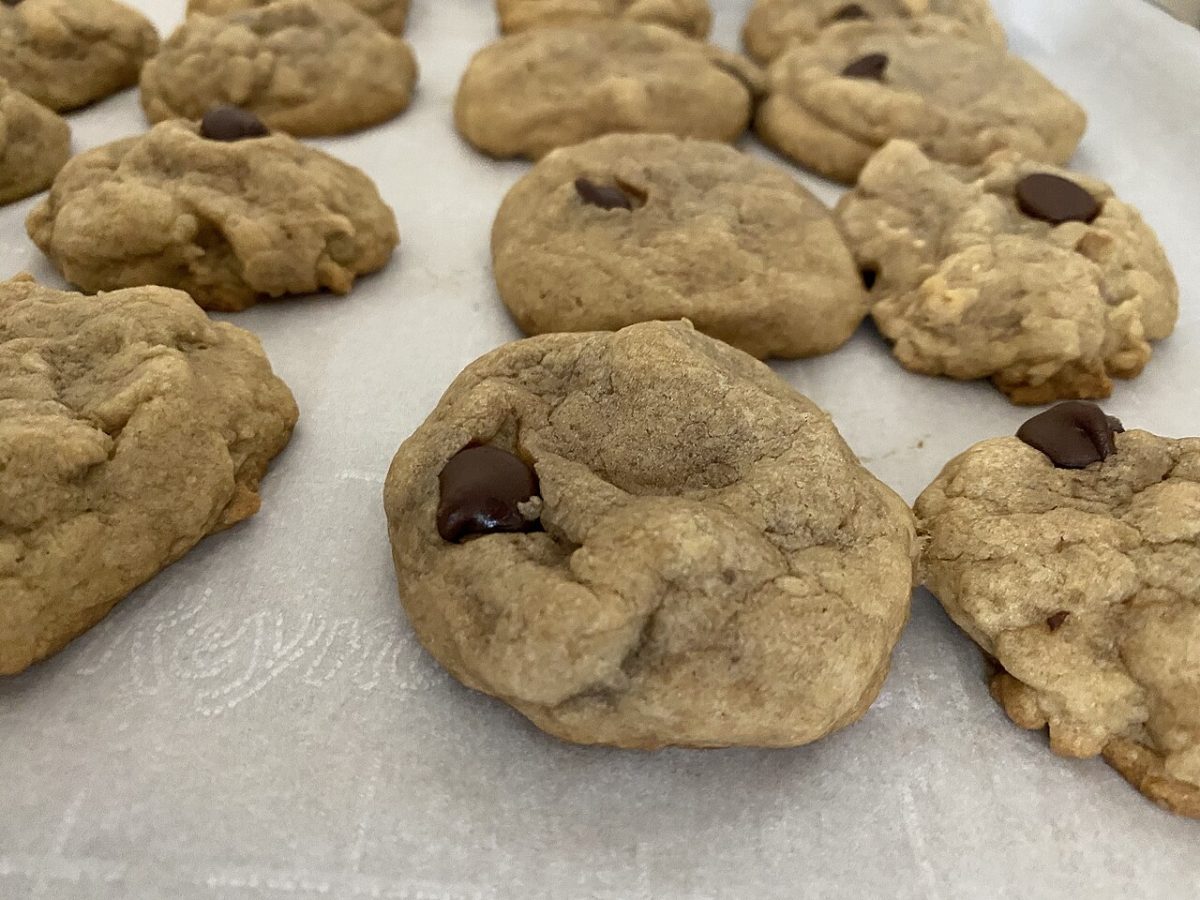
Featured image: “Homemade chocolate chip cookies” by Adlewis, Wikimedia Commons, CC BY-SA 4.0.